Mobile Network Identifiers Explained: MCC, MNC, and PLMN for Global Telecom Research
Introduction
Mobile networks use unique identifiers to distinguish operators and their networks across different countries. These identifiers help telecom systems organize network information and identify specific networks. Three important terms in this field are Mobile Country Code (MCC), Mobile Network Code (MNC), and Public Land Mobile Network (PLMN). Each serves a different purpose in mobile telecommunications. Understanding these codes helps telecom researchers, network engineers, developers, and eSIM users interpret network data correctly. These identifiers also support operator research, roaming analysis, and mobile network database management. However, a code alone cannot confirm that a network is active, available, or compatible with a device. Other factors, such as network coverage, service agreements, and technical requirements, also matter. This guide explains how these identifiers work, how they differ, and how to research mobile network information more accurately.
Understanding Mobile Network Identifiers
Mobile network identifiers are codes used to distinguish mobile networks and organize telecommunications information. They help network systems identify networks within established technical frameworks. Each identifier has a specific purpose, so researchers must understand its meaning before using it.
A country may have several mobile network operators serving different regions or customer groups. Network identifiers help distinguish their assigned networks in technical records. They also support the organization of information in telecom databases and research tools.
Telecom professionals use these identifiers for network analysis, operator research, and troubleshooting. Developers may use them to build applications that organize mobile network records. However, the meaning of an identifier depends on its type, assignment, and technical context.
What Is a Mobile Country Code (MCC)?
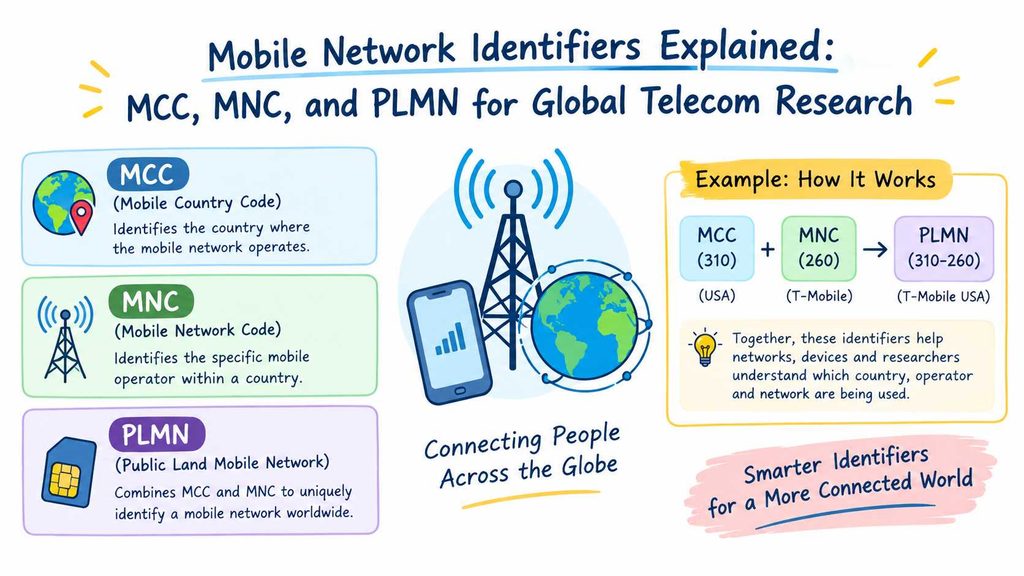
A Mobile Country Code, commonly called MCC, is a three-digit code used to identify a country or geographical area within the mobile network identification system. It forms part of the international identification framework defined by the International Telecommunication Union.
MCC helps distinguish network records associated with different countries or geographical areas. Telecom databases often use it to group mobile network information by location. However, an MCC does not identify an individual operator by itself.
For example, several mobile operators may serve the same country. Their network records may share an MCC while using different MNC assignments. Researchers must examine both fields to understand which network an entry represents.
MCC assignments can also cover certain international network arrangements. Therefore, researchers should avoid assuming that every MCC corresponds directly to one ordinary country. Official assignment records provide the necessary context.
What Is a Mobile Network Code (MNC)?
A Mobile Network Code, or MNC, identifies a mobile network within the applicable MCC framework. Depending on the assignment, an MNC may contain two or three digits. Together, the MCC and MNC form the identifier for a Public Land Mobile Network.
MNC helps distinguish network assignments that share the same MCC. This makes it useful when researching several operators within one country or geographical area. A telecom directory may store the MCC, MNC, operator name, and assignment details in separate fields.
Correct formatting matters when working with MNC values. Researchers should preserve the original digit length and leading zeros where applicable. Different systems may display or encode these values differently, so the expected format must be clear.
Network assignments and operator relationships can also change over time. An operator may change its name, merge with another business, or reorganize its network operations. Older databases may therefore contain outdated names or associations. Checking current assignment records helps reduce these errors.
What Is a Public Land Mobile Network (PLMN)?
A Public Land Mobile Network is a mobile telecommunications network that provides public communication services. Its identifier combines an MCC with an MNC. This combination helps distinguish one network assignment from another.
A PLMN identifier is not necessarily the same as a consumer-facing mobile brand. A familiar brand may operate through another company’s network infrastructure. Similarly, a mobile virtual network operator may provide services without owning the radio network it uses.
PLMN identifiers appear in mobile technologies such as GSM, UMTS, LTE, and 5G. Mobile devices and network systems use this information within procedures for identifying and selecting networks. The exact use depends on the technology and technical procedure involved.
However, a matching PLMN identifier does not guarantee that a device can register on the network. Subscription permissions, roaming agreements, device support, and operator policies can affect access.
Key Differences Between MCC, MNC, and PLMN
Although these identifiers work together, each serves a different purpose. Understanding their roles makes telecom research easier and helps prevent mistakes when organizing network data.
| Identifier | Full form | Main purpose |
|---|---|---|
| MCC | Mobile Country Code | Identifies a country or geographical area |
| MNC | Mobile Network Code | Distinguishes a mobile network assignment within the relevant MCC framework |
| PLMN | Public Land Mobile Network | Identifies a network using the combined MCC and MNC |
The relationship is simple. MCC provides the geographical code, while MNC identifies the relevant network assignment. Combining these values creates the PLMN identifier.
Keeping these fields separate improves database quality. It also helps researchers compare records, investigate inconsistencies, and maintain clear relationships between network assignments and operator information.
How MCC, MNC, and PLMN Work Together
Mobile network systems use these identifiers within established technical procedures. A mobile device may encounter PLMN information while searching for networks or deciding which network to select. The selection process also depends on device configuration, subscription settings, and network policies.
Consider a hypothetical telecom directory entry with an MCC of 123 and an MNC of 45. The combined identifier could be represented as 123-45 for illustrative purposes. These sample values do not represent a verified operator assignment.
The example shows how the two codes form one network identifier. In real systems, the same information may appear in different encoded or displayed formats. A directory may use a hyphen for readability, while a technical system follows its required data format.
Researchers should therefore distinguish between a logical identifier and its stored representation. Preserving the original values helps prevent formatting errors during data imports, exports, and comparisons.
Why Mobile Network Identifiers Matter
Mobile network identifiers support several practical tasks across telecommunications. Their usefulness depends on accurate records and a clear understanding of what each code represents.
Mobile operator research: Researchers can organize operators by country or geographical area. They can also compare network assignments and identify records that need further investigation.
Roaming analysis: MCC and MNC information helps researchers examine home and visited network identifiers. However, the codes alone cannot prove that two operators have an active roaming agreement.
eSIM research: Network identifiers help researchers investigate the networks associated with mobile services. Actual access depends on the eSIM profile, provider agreements, device compatibility, and destination.
Telecom software development: Developers can use structured identifiers to build network directories, data validation tools, and operator lookup systems. Consistent formatting makes these applications easier to maintain.
Network troubleshooting: Engineers may examine PLMN information when investigating network selection or registration problems. They must also consider signal strength, device settings, subscription restrictions, and operator configuration.
How to Research Mobile Network Identifiers Correctly
Reliable telecom research requires more than matching a number with an operator name. Researchers should verify the code, understand its context, and check whether the associated information remains current.
Identify the Required Code
Start by deciding whether you need an MCC, MNC, or complete PLMN identifier. These fields serve different purposes, so choosing the correct one prevents confusion. If you are examining a technical record, check how the source defines each field.
Verify the Assignment
Use authoritative telecommunications records to confirm the relevant assignment. The International Telecommunication Union maintains the international identification framework, while national regulators may publish additional allocation information.
A secondary directory can help you locate relevant records, but important findings should be checked against reliable sources. This is particularly important when the information will support technical decisions or commercial research.
Preserve the Original Format
Record the code exactly as the source presents it. Avoid removing leading zeros or changing the number of digits without understanding the required format. If you convert data between systems, document any formatting changes.
Check Operator Information
Compare the operator name with the available assignment details. Do not assume that a consumer brand owns the network associated with a particular identifier. Virtual operators, infrastructure-sharing arrangements, and corporate changes can complicate these relationships.
Review Dates and Status
Telecom records may become outdated when assignments or business arrangements change. Record when the information was checked and whether the source provides an effective date. If the current status remains unclear, seek confirmation from the relevant authority or operator.
Separate Identification From Availability
A valid identifier does not prove that a network offers service in a particular location. It also does not establish roaming access or compatibility with an eSIM. Treat network identification and service availability as separate research questions.
Common Mistakes When Reading MCC, MNC, and PLMN Data
Small errors can create misleading results in telecom databases. The following mistakes deserve particular attention.
- Confusing a brand with a network operator: A consumer brand may use another company’s infrastructure. Verify the actual operating arrangement before assigning network ownership.
- Changing MNC digit lengths: Adding or removing digits can produce an incorrect value. Preserve the source format and follow the relevant technical requirements.
- Assuming an assignment proves active service: A listed identifier does not confirm that a network is operational or commercially available.
- Ignoring historical changes: Old records may contain former operator names or outdated assignments. Check dates and current information before using them.
- Assuming roaming is automatic: Roaming access depends on agreements, subscription permissions, service terms, and technical support.
- Combining uncertain records: Similar operator names do not prove that two entries represent the same network. Verify their identifiers and relationships first.
- Relying on one unverified source: A single directory entry may contain outdated or incomplete information. Confirm important details using authoritative records.
A consistent verification process helps prevent these errors and improves the reliability of telecom research.
Important Considerations for eSIM Research
MCC, MNC, and PLMN data can help researchers understand mobile network relationships, but these identifiers are only part of the wider eSIM ecosystem.
An eSIM allows a compatible device to download and use a digital mobile subscription profile. That profile may provide access to one or more supported networks, depending on the provider’s agreements and service arrangements.
An eSIM package does not necessarily provide access to every network operating in its destination. Available networks may depend on local partnerships, profile settings, device capabilities, and commercial restrictions. A network identifier alone cannot confirm that a particular eSIM will connect successfully.
Data quality also matters. A reliable telecom directory should distinguish between assigned network identifiers, commercial brands, virtual operators, roaming partners, and eSIM resellers. These categories describe different relationships and should not be treated as interchangeable.
For important technical or commercial decisions, confirm the relevant details with the network operator, service provider, or regulator. This is especially useful when checking network compatibility, roaming access, or service availability.
How eSIMGlobo.com Supports Telecom Research
eSIMGlobo.com is an independent global telecom directory focused on mobile network operators and MCC, MNC, and PLMN identifiers. This type of resource can help readers organize network information and investigate operator records.
Researchers can use a telecom directory as a starting point when studying network assignments across different countries. They should identify the required code, review the associated operator information, and compare important details with authoritative records.
A directory is most useful when readers understand both its purpose and its limits. Organized network information can support research, but it should not replace official verification when accuracy is critical.
By combining structured records with careful checks, telecom researchers can build a clearer picture of mobile network identification and operator relationships.
Frequently Asked Questions
1. What does MCC mean in mobile networks?
MCC stands for Mobile Country Code. It is a three-digit code used to identify a country or geographical area within the international mobile network identification system. It helps organize network records by their assigned geographical code.
2. What does MNC mean in telecommunications?
MNC stands for Mobile Network Code. It distinguishes a mobile network assignment within the applicable MCC framework. Depending on the assignment, an MNC may contain two or three digits.
3. What is a PLMN identifier?
A PLMN identifier represents a Public Land Mobile Network. It combines the MCC and MNC to identify a particular network assignment. Mobile network systems use this information within their identification procedures.
4. How are MCC, MNC, and PLMN related?
MCC identifies a country or geographical area, while MNC distinguishes the relevant network assignment. Together, these codes form the PLMN identifier. Each field serves a different role in mobile network identification.
5. Where can researchers verify MCC and MNC assignments?
Researchers can consult the International Telecommunication Union’s E.212 assignment resources and relevant national telecommunications regulators. These sources help verify official assignments and provide context for interpreting network records.
6. Can an MCC or MNC confirm that a mobile network is active?
No. An identifier can help identify an assigned network, but it does not necessarily prove that the network is operational or commercially available. Researchers should check current operator information when active service matters.
7. Do eSIM providers use MCC and MNC information?
These identifiers can help researchers identify networks associated with eSIM services. However, actual connectivity depends on the subscription profile, provider agreements, destination, device compatibility, and network policies.
8. Does a PLMN identifier guarantee roaming access?
No. A PLMN identifier does not prove that roaming is available between two operators. Access depends on commercial agreements, subscription permissions, service conditions, and technical requirements.
9. Why might an operator appear under different network records?
An operator may have multiple network assignments or operate through different network arrangements. Corporate reorganizations, changes in ownership, and historical records can also affect how an operator appears in a directory. Each record should be checked individually.
10. How can I verify a mobile network identifier?
First, determine whether the value represents an MCC, MNC, or PLMN. Then check the relevant official assignment records, preserve the correct code format, and review the operator association. For service availability, contact the relevant operator or provider.
Conclusion
MCC, MNC, and PLMN identifiers provide a structured way to distinguish mobile networks across countries and geographical areas. Understanding their differences helps researchers interpret telecom records and investigate operator relationships more accurately. However, network identification does not guarantee coverage, roaming access, or eSIM compatibility. Reliable research requires accurate formatting, current records, and verification through authoritative sources. For readers researching global mobile networks, eSIMGlobo.com provides a relevant directory context for exploring operator information and network identifiers.
Leave a Reply